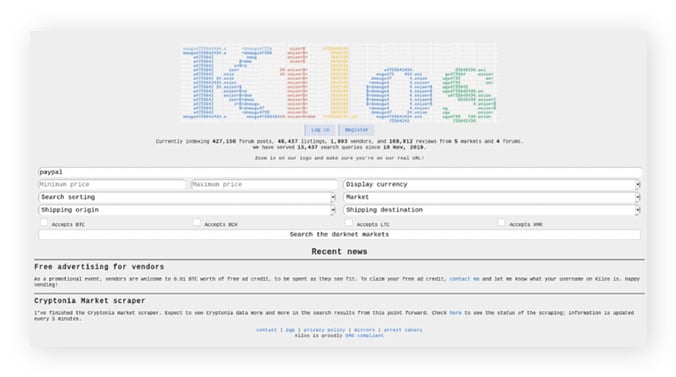

Dark Web Search Engines 2026
The landscape of the dark web search engines 2026 represents a radical departure from the primitive directories of years past. No longer reliant on static link lists, these platforms now leverage decentralized AI crawlers and real-time index farming. Users navigating this ecosystem in 2026 encounter tools that prioritize privacy through zero-knowledge proofs and ephemeral query routing, fundamentally altering how hidden services are discovered.
Core Architectural Shifts
By 2026, dark web search engines 2026 have largely abandoned centralized servers in favor of peer-to-peer indexing. This shift, driven by repeated takedowns of .onion aggregators, means your search query is processed across dozens of volunteer nodes. The result is a fragmented but resilient index where hash-based content addressing prevents blind spots, though it introduces significant latency for niche queries.
Principal photography for the second season took place on location in Berlin from June 2018 until November 2018. The gates to the power plant are those at the Olympic Stadium Bell Tower; the nuclear reactor towers were computer-animated. Jonas and Martha travel to the origin world through the passage in the cave and successfully save Tannhaus' family, thereby erasing both worlds from existence.

Semantic vs. Blind Crawling
A key differentiator among dark web search engines 2026 is their crawling methodology. Traditional blind crawlers are now legacy systems, outpaced by semantic engines that infer context from encrypted metadata. For example, a query for "discreet marketplaces" in 2026 might return hyper-specific results based on transaction fingerprints rather than page titles. This evolution reduces noise but raises concerns about filter bubbles within hidden networks.
Security and Verification Paradox
Trust mechanisms in dark web search engines 2026 have become both more sophisticated and more fragile. Many engines now embed web-of-trust signatures directly into search results, allowing users to verify that a .onion site hasn't been compromised. However, this same technology enables Sybil attacks where malicious actors fabricate trust scores. The balance in 2026 tilts toward behavioral analysis—engines track how long a site has been indexed and its response consistency.
- The second season introduces Sic Mundus Creatus Est, a major faction in the ongoing battle for the ultimate fate of the people of Winden and the world.
- Fans often find themselves amazed at how well the pieces fit together when revisiting the series.
- The second season continues the families' attempts to reunite with their missing loved ones several months after the first-season finale, in 2020, 1987 and 1954, respectively.
- In the power plant, Clausen opens the drums containing rocks soiled with dark matter.
- The third and final season received critical acclaim, with the series finale receiving particular praise for being a satisfying conclusion to the story.
- The season was included in many critics' year-end lists of 2019.
Emerging Use Cases Beyond Illicit Trade
Contrary to popular perception, dark web search engines 2026 are increasingly used for legitimate purposes: whistleblowing signal relays, underground academic archives, and censorship-circumventing news aggregators. In regions with heavy internet censorship, these engines serve as the only gateway to unmediated information. The mainstream adoption of encrypted messaging has inadvertently driven traffic, with users seeking to verify sources outside of clearnet surveillance.
The Usability Bottleneck
Despite technical leaps, dark web search engines 2026 still suffer from a usability gap compared to their clearnet counterparts. The average query takes 4-7 seconds longer, and result pages are text-heavy with minimal CSS for security reasons. Newer engines experiment with progressive image loading for screenshot thumbnails, but this risks metadata leakage. The trade-off between convenience and anonymity remains the defining challenge of the year.
Looking Forward: Quantum Resistance
As quantum computing edges closer to practicality, dark web search engines 2026 are already integrating post-quantum cryptography for their query protocols. Early adopters use lattice-based encryption to ensure that today's search logs cannot be decrypted retroactively. This forward-thinking approach suggests that while the surface web debates quantum threats, the dark web has already hardened its infrastructure for the coming decade.